HEBERLING LAB

  • Welcome
  • People
  • Publications
  • Photos
  • Collected on this day!
  • Welcome
  • People
  • Publications
  • Photos
  • Collected on this day!

Collected on this day...

a weekly blog featuring specimens in the Carnegie Museum herbarium.
Each specimen has an important scientific and cultural story to tell.
This material is based upon work supported by the National Science Foundation grant no. DBI 1612079 (2017-2019) and DBI 1801022 (2019-2022). Any opinions, findings, and conclusions or recommendations expressed in this material are those of the author(s) and do not necessarily reflect the views of the National Science Foundation.
April 17, 1998: 22 years ago

4/17/2020

Comments

 
Picture
Find this specimen here:
​http://midatlanticherbaria.org/portal/collections/individual/index.php?occid=1235336
​Spontaneous mints in your backyard
 
This specimen of purple dead-nettle  (Lamium purpureum) was collected on April 17, 1998 by Kevin McGowan and Meggan Scanlon near Settler’s Cabin County Park in Oakdale, PA on property that is now the Pittsburgh Botanic Garden.  As seen in the title of the specimen label, it was collected as part of a biological survey for the planning of the site, a large ongoing restoration of the formerly mined property.
 
Purple dead-nettle is probably in your backyard. Or if not, you likely don’t have to go far to find it in a lawn or sidewalk crack.   Some call it a “weed.” Or, in the case of in your lawn, “spontaneous vegetation” is a lighter hearted term. It is native to Europe and Asia but now widespread across the world, including North America.
 
Purple dead-nettle is not related to stinging nettle, despite the name.   It was named “dead-nettle” because is reminiscent to nettles (well, at least to whoever came up with the common name) but does  not have stinging hairs.
 
Purple dead-nettle is in the mint family (Lamiaceae) with square stems often characteristic of mints.  Try rolling the stem between your fingers and you’ll notice the square stems.
 
The City Nature Challenge is just around the corner (April 24-27)! The City Nature Challenge is a global event where cities come together to share the biodiversity seen in their urban areas. Your nature sightings are shared through the free community science platform, iNaturalist. If you have never used iNaturalist, the City Nature Challenge is a great way to introduce yourself to iNaturalist.  You’ll be hooked.
 
Past years have been (friendly) competitions among cities, competing for the most observations or species. But given the current pandemic, this year is different.  It is not about the number of observations you make. It is a celebration of nature, wherever you can safely be this year...which for most, is your backyard!  Or the sidewalk near your house. Or the parking lot. Or a local park. Or maybe even inside your house.
 
Keep a look out for purple dead-nettle.  You won’t have to go far!
 
Last year’s City Nature Challenge Pittsburgh 2019, this species was the 9th most observed species!
 
Or if you can’t safely be outside, you can view other observations on iNaturalist.org at any time!  You can help identify photos or just click around and go for a virtual botanical hike around Pittsburgh!
 
Or look online at Carnegie Museum’s 185 herbarium specimens of purple dead nettle, going back to 1826 in England! (though this one hasn’t yet been imaged).    Or this one growing 138 years ago collected in Beaver county.
 
However you can, there are plenty of ways to participate and connect with nature while staying safe!
Picture
Lamium purpureum was the 9th most observed species in the Pittsburgh region for last year’s City Nature Challenge 2019.  Here’s an observation of purple dead-nettle from last year’s challenge from the flower bed near the Dippy statue at the Carnegie Museum of Natural History.
Comments

March 21, 2012: 8 years ago

3/21/2020

Comments

 
Picture
“Who are you calling a pansy?”
 
This specimen of wild pansy (Viola bicolor) was collected on March 21, 2012 along the Monongahela River in California – California, Pennsylvania that is!  Allison Cusick collected this specimen. Allison is a former state botanist in Ohio and currently an active research associate at Carnegie Museum.
 
Wild pansy, also called field pansy, is in the same genus as violets (Viola. It is said to be the only pansy native to North America, though there is some debate if it was introduced.
 
This species is a relative of garden pansies, which are hybrids of different Viola species.
 
Pansies are actually pretty tough.  Blooming early and can be found in disturbed habitats like lawns and roadsides.
 
Find this specimen here: http://midatlanticherbaria.org/portal/collections/list.php?db=all&catnum=CM526628&othercatnum=1
Comments

March 20, 1919: 101 years ago

3/20/2020

Comments

 
Picture
It may be spring on your calendar...but most trees aren’t quite ready.
 
This leafless specimen of white ash (Fraxinus americana) was collected on March 20, 1919  by  E.M. Gress in “Frick’s Woods” in Pittsburgh. Frick Park is now a major city park in Pittsburgh, much loved by many.  It became a city park in 1919 (the same year this specimen was collected!), bequeathed to the city upon the death of industrialist Henry Clay Frick.  Earnest Milton Gress was the state botanist for the Pennsylvania Department of Agriculture. While we don't know for sure why Dr. Gress collected this specimen (and at least 6 others), it may be as part of property surveys for a possibly new public park.
 
As you can see from this specimen, white ash is usually still leafless this early in the spring. White ash is an economically and important species in Pennsylvania, with a wide distribution across the eastern US.  However, white ash (and other ash species) are in rapid decline due to the introduction of the Emerald Ash Borer (Agrilus planipennis), a beetle native to north-eastern Asia. The beetle lays eggs under the bark  of the species, and the larvae feed on the tree. It is causing the death of many ashes in North America and Europe. It was first discovered in the US in Michigan in 2002, and first documented  in Pennsylvania in 2012.  It is a relatively recent introduction. As an active invasion, the consequences are  still developing.  Read more here about emerald ash borer’s wide-ranging impacts to our forests:  https://www.fs.fed.us/nrs/pubs/jrnl/2019/nrs_2019_knight_001.pdf
 
Side note: The label shows the specimen was once part of the “Herbarium of Bureau of Economic Zoology, Penna. Dept. Agr. Harrisburgh, PA.”  Who knew the bureau of zoology (animals) had an herbarium!?
 
Find this specimen and the other specimens Gress collected at “Frick’s Woods” here: http://midatlanticherbaria.org/portal/collections/list.php?db=all&county=allegheny&eventdate1=March+20%2C+1919
Comments

March 19, 1898: 122 years ago

3/19/2020

Comments

 
Picture
Spring goes on!

Spring seems to happen fast, which makes it all the more special and worth our attention. Comfort can be found in the new life of spring, a time of change.
 
Happy official first day of spring! For many people, spring conjures of sunshine (and rain), birds tweeting about, and plants emerging from winter. Trees flower and leaf out high up in the canopy. Wildflowers emerge below, many playing a delicate balance between getting injured by cold or frost but taking advantage of the longer sunny days before being shaded out by tree leaves.
 
Many deciduous trees flower before, during, or just after they produce a new spring flush of leaves. That’s right – trees flower too! Keep a careful look out for them now and over the coming month. Many trees flower early in the spring, with small clusters of flowers. These easy to overlook flowers 40 feet or more up in the canopy are easy to overlook.  They are often quite small and are wind pollinated. That means that rather than relying on insects, the wind blows their pollen, transferring it to female flowers. (And also...as many with allergies know, we breathe in pollen too...)  Upon fertilization, seeds begin to develop. Flowering early, before leaves are out, is adaptive because the flowers are not blocked by vegetation.
 
This specimen of silver maple (Acer saccharinum) is in flower, but leaves are not yet emerged. Silver maple is native to swampy, wet areas such as around lakes across eastern North America.  It is also planted, so it is now found in many habitats. It has beautiful bark that forms distinctive strips and with “maple-looking” leaves that are deeply loped.
 
Beyond the science, this specimen also tells an important cultural story about the history behind the Carnegie Museum.  This specimen was collected by Otto Jennings in Olena, Ohio in 1898.  Otto Jennings was one of the first curators of botany at the museum. This specimen was collected when he was only 20 years old, six years before he moved to the museum. He was born in 1877 on a farm in Olena, Ohio. He collected this specimen not far from his childhood home.  Jennings started his 60-year tenure at the Carnegie Museum six years later, in 1904. He made many contributions throughout his career, serving as the Curator of Botany, Director of Education, and eventually Director of the Carnegie Museum of Natural History.  He also was Professor of Head of the Department of Biological Sciences at the University of Pittsburgh, having advised many students.  His legacy remains to this day for his influence on the museum, botany, conservation, and environmental education.
 
So many stories behind these specimens.
Picture
Picture
Comments

March 18, 1951: 69 years ago

3/18/2020

Comments

 
Picture
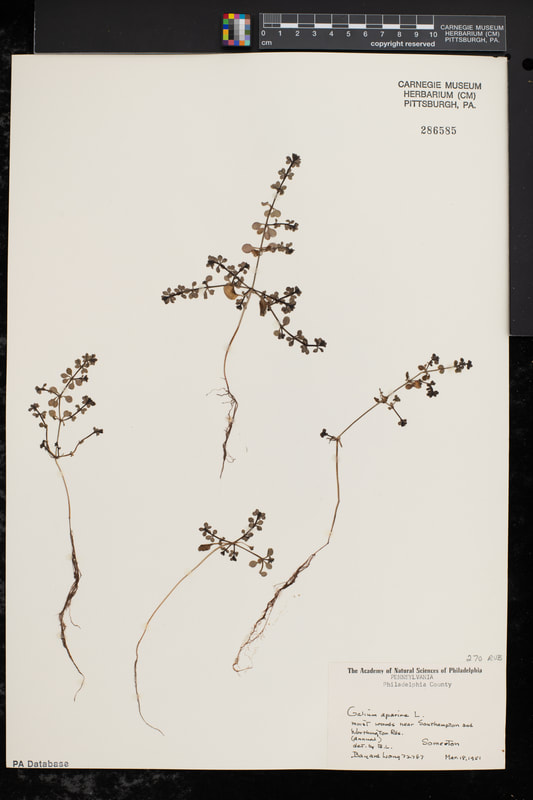
Lay down on this.

This bedstraw specimen was collected on March 18, 1951 by Bayard Long in Philadelphia county, Pennsylvania.
 
Bayard Long (1885-1969) was a Philadelphia-area botanist and an active member of the Philadelphia Botanical Club (founded in 1891 and still exists today).  He was a prolific collector and served as Curator of the Club’s Local Herbarium for 56 years (housed at the Academy of Natural Sciences).
 
Fogg writes of his collections in 1970 in the journal Rhodora: “It is doubtful that anyone ever possessed a higher standard for the quality of an herbarium specimen than Bayard Long.  Every leaf had to be laid out flat, every inflorescence properly displayed, every flower part clearly shown. Extra flowers and loose fruits and seeds were placed in pockets affixed to the sheet. Root systems (collected in their entirety whenever possible) were scrupulously clean, habitats were accurately described and localities were identified to the nearest tenth of a mile and closest compass point. All of this seems the more remarkable when it is realized that Long collected close to 80,000 numbers, not including collections made as a member of Fernald’s expeditions.”
 
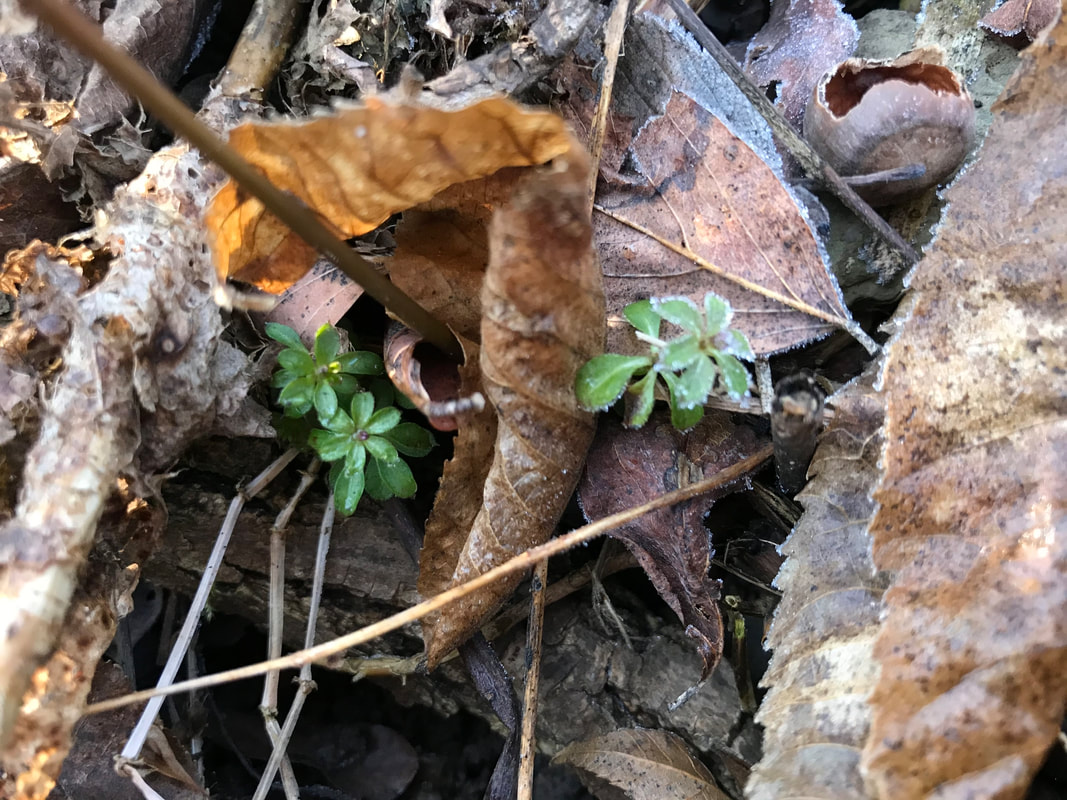
Bedstraws (species in the genus Galium, in the coffee family Rubiaceae) are common and memorable in our woods. They have many historical and traditional uses. In particular, they were used to stuff mattresses, hence the funny name.  Also called cleavers or catchweed, the stems are sticky (due to fine hook hairs) and can be fun to stick on your clothes.  They have likely stuck to you or your pet. This specimen is Galium aparine. An annual plant, seeds germinate in spring and produce tiny white flowers. They are emerging now, poking through the leaf litter.
 
Find this specimen and more here: http://midatlanticherbaria.org/portal/collections/list.php?db=all&catnum=CM286585&othercatnum=1
 
There are >64,000 specimens collected by Bayard Long currently digitized and online!: http://midatlanticherbaria.org/portal/collections/list.php?db=all&collector=Long
Picture

Comments

March 16, 1952: 68 years ago

3/16/2020

Comments

 
Picture
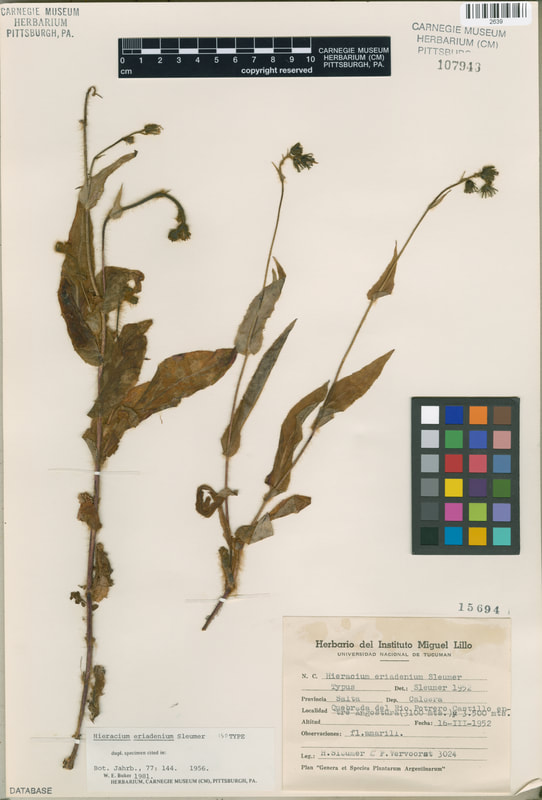
This hawkweed specimen was collected on March 16,  1952 in Argentina by Hermann Otto Sleumer, a Dutch botanist who lived from 1906-1993 who published over 1,422  plant names, describing these species new to science!
 
And this species was one of them: Hieracium eriadenium Sleumer.  The scientific binomial name is in italics  (genus species) followed by the botanical authority (here, “Sleumer”).   This denotes that Sleumer published the description of the species.
 
In fact, Sleumer actually cited this specimen in the publication four years  after  it was collected (1956), thereby making this specimen a “type” specimen.  Type specimens are of special scientific importance, as they are designated specifically to define the species. 
 
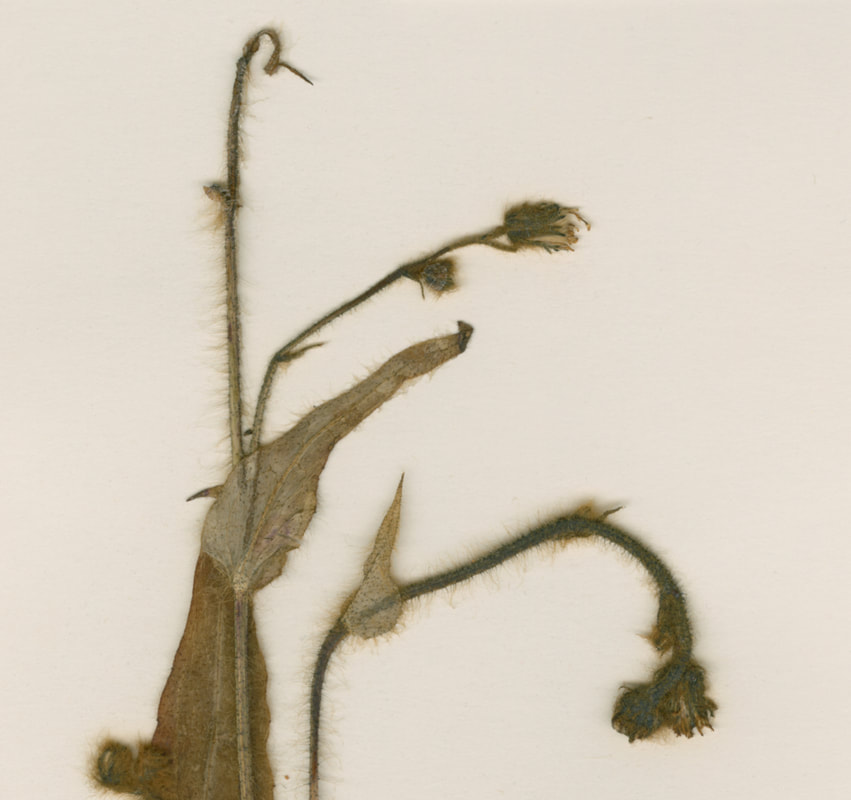
Herbarium hairs
 
Hawkweeds (in the genus Hieracium) are in the sunflower/composite family (Asteraceae). As can be seen in this specimen, these species tend to be especially hairy.  Some species are introduced outside of their natural range and considered invasive and  actively spreading.
 
One study used digitized specimens of Hieracium to measure the effects of UV-B (ultraviolet-B) radiation on the density of hairs and length of hairs across native and  introduced  ranges  (Northern and  Southern hemispheres).  The found longer leaf hairs and more dense hairs correlated to higher UV-B. Leaf hairs were longer in their introduced range (Southern hemisphere).  This study was possible because of digitized specimen images.  Find this 2017 study here: https://journals.plos.org/plosone/article?id=10.1371/journal.pone.0175671 
 
Find this specimen and more here: http://midatlanticherbaria.org/portal/collections/list.php?db=all&catnum=CM107943&othercatnum=1
Picture
Comments

February 29, 1984: leap day specimen

2/29/2020

Comments

 
Picture
Picture
nUnnamed, but not forgotten!
 
Today, we celebrate the 9th birthday of this specimen...that was collected 36 years ago.
 
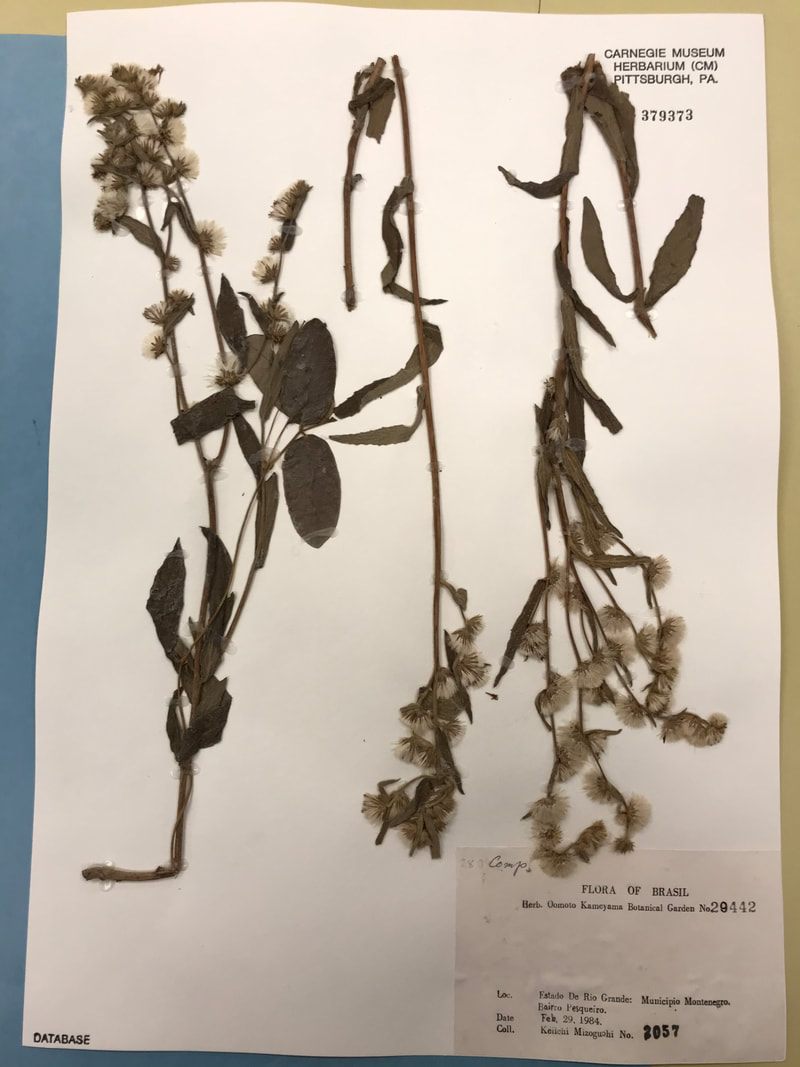
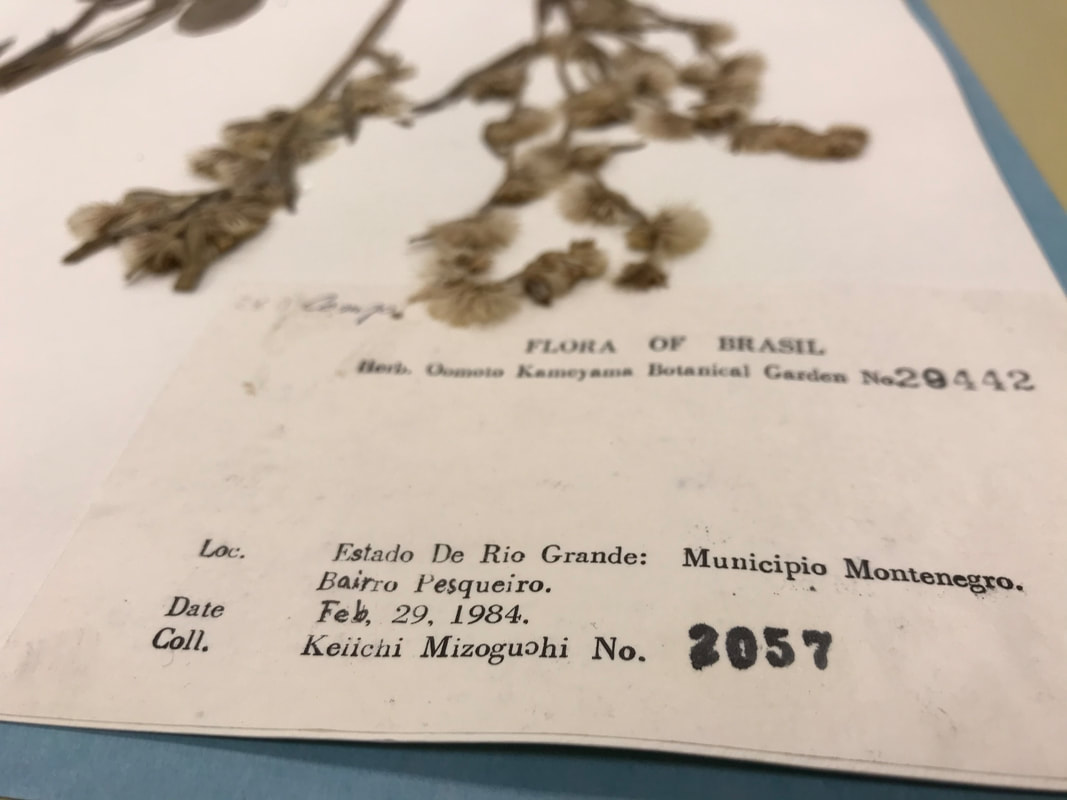
This specimen was collected on leap day, February 29, 1984 in Brazil by Keiichi Mizoguchi.
 
Fun fact: The Carnegie Museum herbarium includes 85 specimens collected on leap day, collected between 1872 until 1990.  That’s a lot of leap years!
 
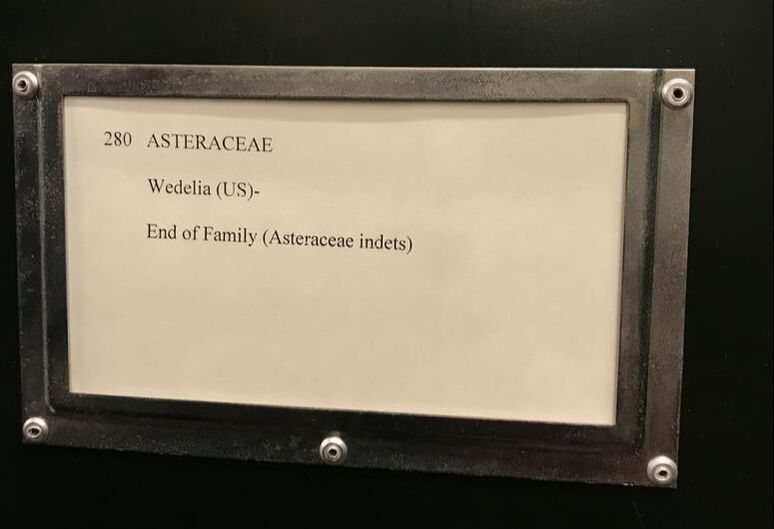
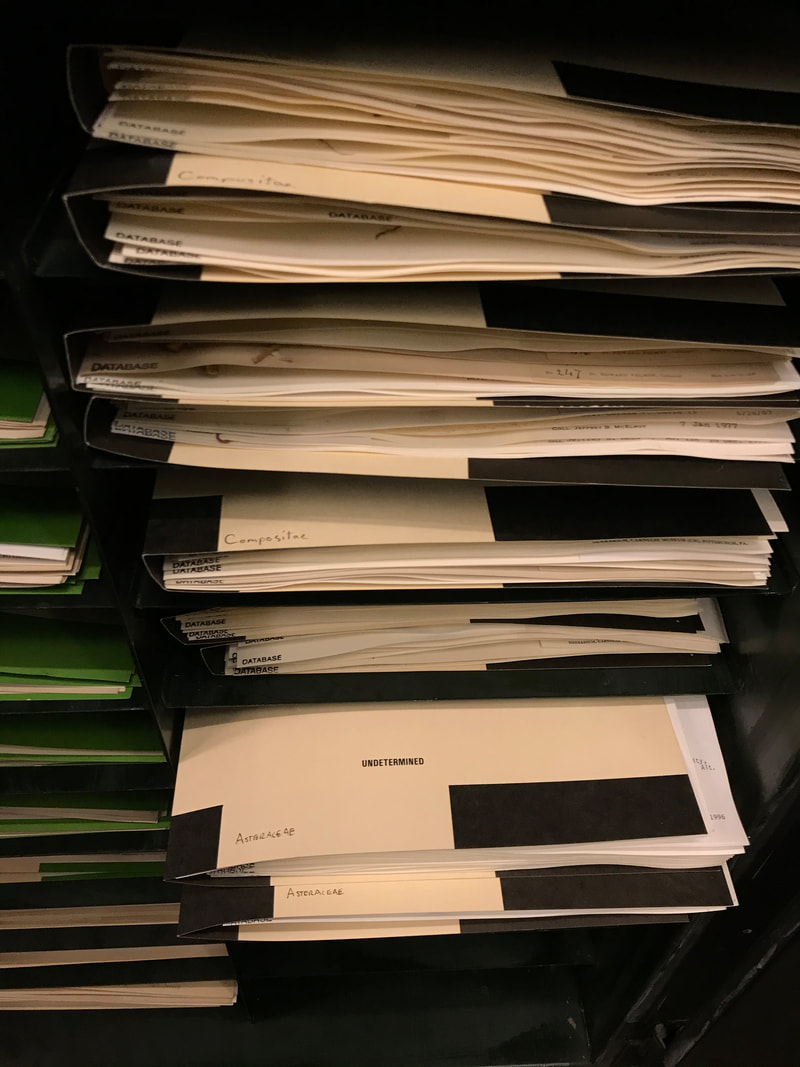
Aside from it being collected on leap day, the specimen label might seem even more unique.  Where most herbarium specimen labels have the species name, this one is blank. A big blank spot. The collector did not identify this specimen, nor has anyone else in the past 36 years (yet).  This is an “indetermined” or unidentified specimen.  It is filed in the sunflower family (Asteraceae) based on its flowers, but it is otherwise not identified.
 
We can’t forget about these unidentified specimens.  Especially those collected on leap day!
 
Specimens in the herbarium are arranged by plant family, then genus, then geography (where it was collected), and in nearly every genus, at the bottom of all these folders is a black colored folder labelled “undetermined” (also called “indet.”) that includes those specimens that have not yet been identified to species.  Of the over 525,000 specimens in the Carnegie Museum herbarium, about 2% (= 10,588 specimens), are not (yet) identified to species.
 
This specimen is most likely a member of a species already known to science, but an expert has not yet identified this particular specimen yet.  However, many undetermined specimens may be undescribed (that is, new to science!).  The name and description of new species (alpha taxonomy) is a major purpose of herbaria.  A study in 2010 estimated that of the estimated 70,0000 species yet to be described, over HALF are lying in herbaria right now!  They also found that only 16% of new species descriptions were done within 5 years of specimen collection, and 25% of new species descriptions involved specimens that were more than 50 years old!
Study abstract here: http://www.pnas.org/content/107/51/22169.abstract
 
Taxonomy (branch of science on classification of organisms) is always changing.  Species names are changed, what was once thought to be one plant species or family is split into many, and what was thought to several species is lumped into one.  And with further information or upon review by experts in particular plant groups. specimens are determined to be a different species than what the original collector called it.  Annotation labels are added to specimens all the time – these labels revise the species listed on the original label.  A typical annotation label includes the revised species name and details, the name of the person making the annotation, and the date.
 
Some specimens can have many annotations, which nicely demonstrates the community culture of science as a process with constant revision as we learn more about the world around us.
 
Find this specimen here: http://midatlanticherbaria.org/portal/collections/individual/index.php?occid=12339031&clid=0

Check back, maybe it'll have a species name on it by next leap year!

Picture
Picture
Comments

February 21, 1984: 36 years ago

2/21/2020

Comments

 
Picture
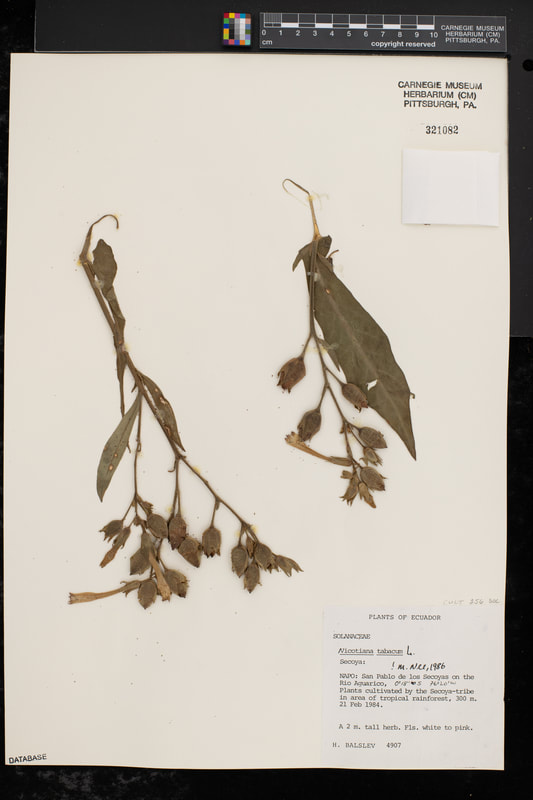
Put that in your pipe and smoke it!
Well, please don’t, really. This is a scientific specimen.
 
This tobacco specimen was collected in Ecuador by Hendrik Balslev on February 21 1984. Hendrik Balslev is now a professor at Aarhus University, Denmark, who studies the taxonomy and ethnobotany of plants of the Amazon. This specimen was planted by the Secoya tribe in the “area of tropical rainforest.” The Secoya are a group of indigenous peoples, with a distinct culture and language, living in the Amazon regions of Ecuador and Peru.
 
Tobacco refers to more than 70 species of plants in the genus Nicotiana. In the nightshade family (Solanaceae), tobacco is related to deadly nightshade, potatoes, and tomatoes. They famously contain the addictive alkaloid stimulant chemical nicotine. Nicotine is a neurotoxin for insects, produced by plant for its insecticide properties.  For that reason, tobacco has also been used as an insecticide.
 
Tobacco is a culturally important plant, far beyond a pack of cigarettes. The commonly cultivated species is Nicotiana tabacum. Tobacco has rich, long history of medicinal and traditional use in the Americas, especially Mesoamerica and Caribbean, and with many native American tribes growing and using tobacco for centuries. It was used for smoking, in religious ceremonies, socially, as a sign of peace (peace pipes), as a good for trade, and more. There is evidence suggesting its cultivation in Mexico as early as 1500 BC.
 
When Europeans arrived in the Americas, tobacco was quickly prized and popularized in Europe.  Tobacco was influential in European colonization in North America, becoming a major cash crop. Tobacco was important to the history of the United States, but with a dark side. Many of America’s founding fathers had tobacco plantations, mostly operated through slave labor. The cultivation of tobacco fueled the early slave trade in 17th and 18th century America.  The number of slaves from Africa in the Chesapeake region (Virginia) and North Carolina increased greatly.   
 
A complicated plant – botanically and culturally.
 
Find this specimen and more here: http://midatlanticherbaria.org/portal/collections/list.php?db=328&catnum=CM321082&othercatnum=1


Comments

February 15, 2006: 14 years ago

2/15/2020

Comments

 
Picture
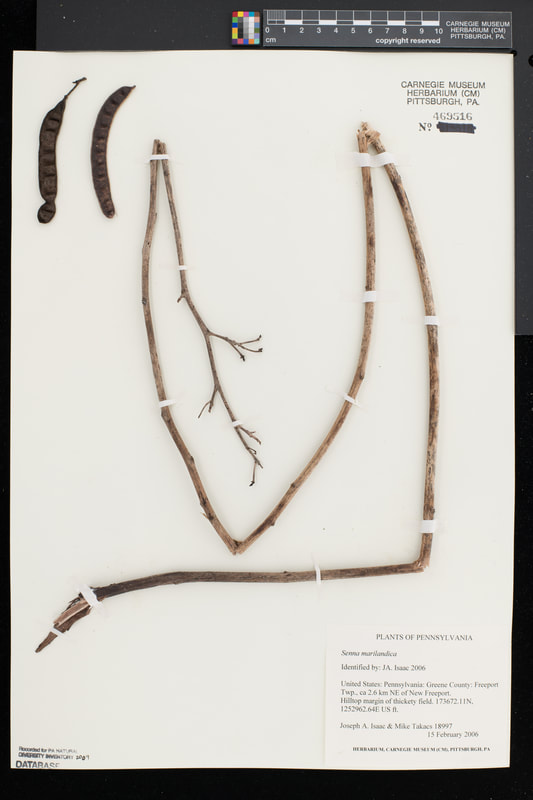
There's something unique about this specimen. There's a certain aesthetic to the folded, smile-like arrangement of the winter collected stem bent back and forth around the sheet. Fruit pods in the corner. Maybe it is just me.

This specimen of Maryland senna (Senna marilandica), also called wild senna, was collected by Joe Isaac and Mike Takacs on Febrary 15, 2006 in Freeport Township, Greene County, Pennsylvania. 

Wild senna flowers is semi-shrub/herbaceous perennial native to the US, primarily in the midwest and southerneastern states.  It flowers in the summer that develop into characteristic pea-pod like fruits, which makes sense since it is in the pea/legume family (Fabaceae).

It is a species of conservation concern in Pennsylvania, tracked by the state as Rare. More here. 

​Herbarium specimens are critical to determining whether a species is rare or not.

Find this specimen image online at http://midatlanticherbaria.org/portal/collections/list.php?db=328&catnum=CM469516&othercatnum=1​
Comments

January 31, 2012: 8 years ago

1/31/2020

Comments

 
Picture


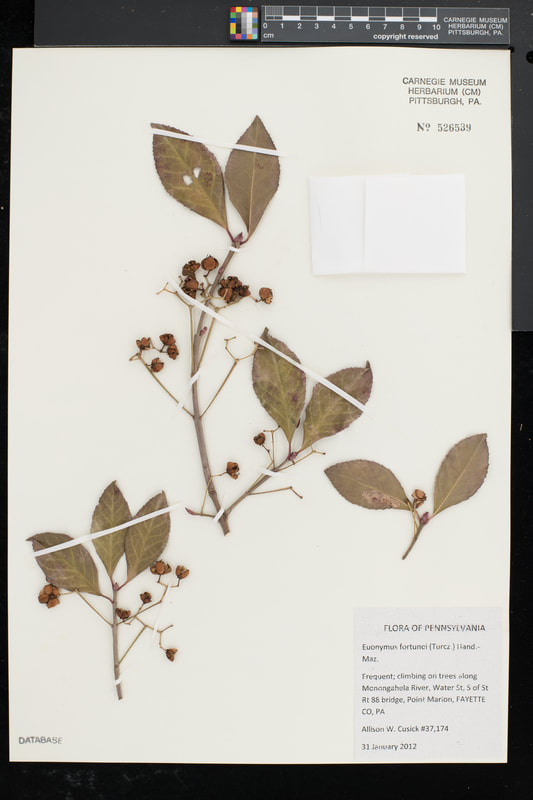
​This specimen of winter creeper (Euonymus fortunei) was collected on January 31, 2012 along the Monongahela River in Fayette County, PA by Allison Cusick.  Allison Cusick is a current Research Associate in the Section of Botany at the museum.  He can be frequently found in the Carnegie Museum herbarium.  He has a unique wealth of knowledge on plants, herbaria, botanical history, and more.  He authored three books and more than 50 scientific papers on the flora of eastern North America. Before retiring, he was the Chief Botanist for the Ohio Department of Natural Resources.  He continues to collect today, and many thousands of his specimens can found at herbaria across the country. 
 
Note the label on this specimen reads “Cusick, A.W.  37174”  The number following a collectors name is known as the...you guessed it... collector number (surprise!).  The collector number is the number assigned to a specimen by the collector.  It is common for several specimens to have the same collector number, if they are from the same individual or species in the same location on the same day (“duplicate specimens”).  Unfortunately, there are no universal rules on how collector numbers are used or assigned.  Collector numbers primary use is so the collector and/or others using the specimen can go back to the collector’s field notebook for additional information on the specimen.  Collector numbers are different from specimen numbers (which are assigned by the herbarium, such that every specimen has a unique ID for reference).  Most collectors number their specimens chronologically in order they were collected (but not always), but some collector numbers consist of dashes and/or letters, too. 
 
Anyway, what I’m getting at is that this specimen (Cusick 37174) suggests Allison has collected AT LEAST over 37,000 specimens.  The number is actually higher than that, with duplicates and an additional 8 years of collecting.  Not that numbers are everything, but Allison’s contribution to the herbarium record is clearly impressive and impactful.
 
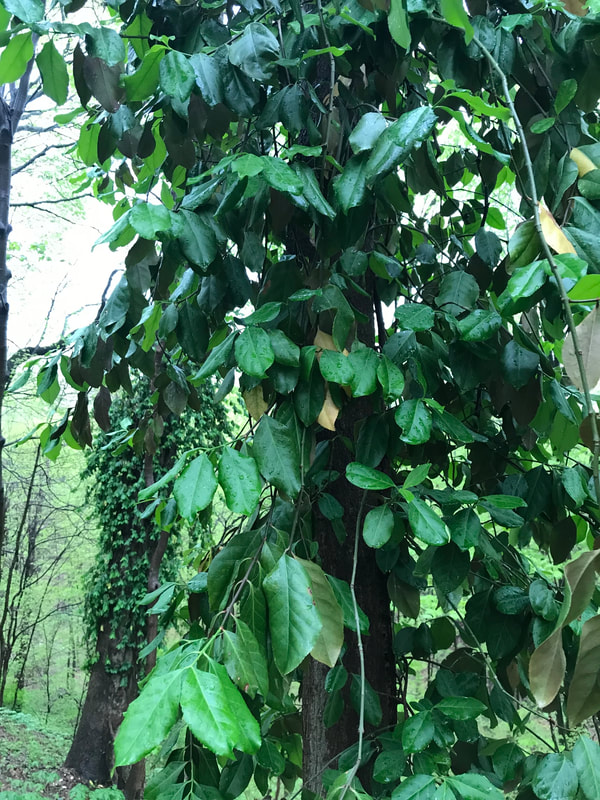
Ok, now back to the plant!  Winter creeper (Euonymus fortunei), native to Asia, is commonly planted in Pennsylvania and many other places, and unfortunately has also spread to become invasive.  It is still commonly planted.  It is a woody vine that climbs trees, but also is a thick ground cover.  It has leaves that persist through the winter, with attractive fruits.  Despite those advantages, it can impact native species and habitats as an invasive species, and therefore, should not be planted.
 
Find this specimen and more here: http://midatlanticherbaria.org/portal/collections/individual/index.php?occid=12134036&clid=0

Picture
Comments
<<Previous
Forward>>

    RSS Feed

      Suggest a specimen!

      Your birthday, favorite species, collected by your house, a particular collector, etc...?
      [object Object]
    Submit

    Archives

    September 2025
    January 2025
    October 2024
    January 2024
    September 2023
    May 2023
    October 2022
    April 2022
    January 2022
    December 2021
    November 2021
    October 2021
    August 2021
    July 2021
    June 2021
    May 2021
    March 2021
    February 2021
    January 2021
    December 2020
    November 2020
    October 2020
    September 2020
    July 2020
    June 2020
    May 2020
    April 2020
    March 2020
    February 2020
    January 2020
    December 2019
    November 2019
    October 2019
    September 2019
    August 2019
    July 2019
    June 2019
    May 2019
    March 2019
    February 2019
    January 2019
    December 2018
    November 2018
    October 2018
    September 2018
    August 2018
    July 2018
    June 2018
    May 2018
    April 2018
    March 2018
    February 2018
    January 2018
    December 2017
    November 2017
    October 2017
    September 2017
    August 2017
    July 2017
    June 2017
    May 2017
    April 2017
    March 2017
    February 2017
    January 2017

    Categories

    All
    Amaryllidaceae
    Anacardiaceae
    Apiaceae
    Apocynaceae
    Aquifoliaceae
    Araceae
    Araliaceae
    Asparagaceae
    Asteraceae
    Balsaminaceae
    Betulaceae
    Boraginaceae
    Brassicaceae
    Cactaceae
    Caprifoliaceae
    Caricaceae
    Caryophyllaceae
    Celastraceae
    Climate Change
    Convolvulaceae
    Cornaceae
    Cucurbitaceae
    Cultivated
    Cupressaceae
    Dioscoreaceae
    Dryopteridaceae
    Ericaceae
    Euphorbiaceae
    Fabaceae
    Fagaceae
    Geraniaceae
    Hamamelidaceae
    Holiday Posts
    Introduced Species
    Lamiaceae
    Lauraceae
    Life History Series
    Liliaceae
    Limnanthaceae
    Lycopodiaceae
    Magnoliaceae
    Malvaceae
    Melanthiaceae
    Melastomataceae
    Montiaceae
    Myristicaceae
    Oleaceae
    Onagraceae
    Orobanchaceae
    Oxalidaceae
    Papaveraceae
    Paulowniaceae
    Pinaceae
    Plantaginaceae
    Plants Of The Anthropocene
    Poaceae
    Poisonous
    Polemoniaceae
    Polygonaceae
    Primulaceae
    Pteridaceae
    Ranunculaceae
    Recollected
    Recollection
    Rhamnaceae
    Rosaceae
    Rubiaceae
    Salicaceae
    Santalaceae
    Sapindaceae
    Scrophulariaceae
    Simaroubaceae
    Solanaceae
    Staphyleaceae
    Type Specimens
    Ulmaceae
    Undetermined
    Urban Plants
    Violaceae
    Vitaceae